question_mark Why Use a Sandbox? Challenges to Utility Innovation and Technological Change
Certain aspects of current utility regulatory frameworks and can stifle innovation. Creating an ecosystem of innovation for utilities requires reducing or removing these hurdles. Regulatory sandboxes are one tool to address these issues.
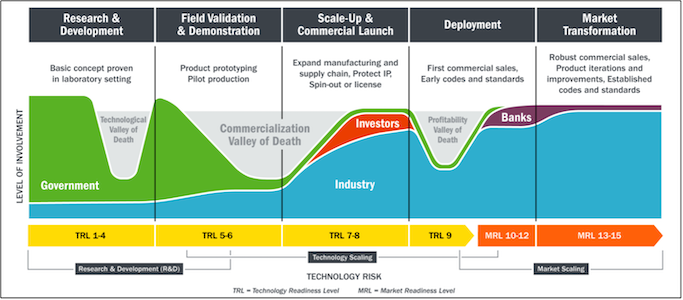
Adoption of advanced grid technologies, however, is typically slow. The process includes research and development (R&D), field validation and demonstration, scale-up and commercial launch, deployment, and market transformation. Utilities generally procure technologies in the market transformation stage, when the level of risk is low
Technology to Market Process (Source: U.S. DOE, ND)
Characteristics, including those below, of the regulated utility sector and major regulatory barriers that limit utility innovation and adoption of advanced grid technologies.
Type of Barrier to Innovation
business_center Cost of Service Regulation and Cost Recovery
Traditionally, utilities operate under cost-of-service regulation in which utilities recover an authorized amount of revenue sufficient to fund their expenses and provide a reasonable return on capital investments. Under this model, utilities profit by investing in capital-intensive projects. This creates an incentive for utilities to propose and build large, utility-owned infrastructure. Some advanced grid technologies are owned by customers or third parties and typically do not provide an opportunity for utilities to earn a return, since they are not making the investment. That creates a disincentive to technology solutions that offset the need for new grid infrastructure.
How do Regulatory Sandboxes Offer Solutions?
How do Other Innovation Vehicles Offer Solutions?
Sandboxes can place an explicit focus on certain non-capital investments and on innovation.
Performance-based regulation (PBR) can reduce capex bias and steer utility focus toward outcomes that may require innovation.
Utilities are risk-averse. Utility costs are reviewed and approved for inclusion in retail rates for customers. Costs incurred by investor-owned utilities that are not recovered through retail rates are borne by shareholders, impacting profitability and their ability to make needed investments in the future. In approving costs, regulators must consider whether customer rates are just and reasonable and provide the utility a reasonable opportunity to earn a return on investments that are prudently incurred and used and useful.
This creates a strong incentive for utilities to invest in well-proven technologies. Innovative projects or investments may lack a strong evidence base that utilities can use to demonstrate to regulators and consumer advocates that the investment will be beneficial to customers. In addition, some advanced grid expenditures — e.g., software as a service or customer-owned energy storage systems — typically do not provide an opportunity for the utility to profit. That creates a lopsided risk equation, in which the utility’s only upside is recovering their costs, and the downside could include cost disallowance or penalties. In addition, the ability to pass costs onto customers reduces the utility's incentive to innovate in ways that will bring down business costs and improve profitability overall.
How do Regulatory Sandboxes Offer Solutions?
How do Other Innovation Vehicles Offer Solutions?
Sandboxes can create upfront assurances that cost recovery will be allowed for projects that conform to identified expectations.
Dedicated funding amounts create more certainty of funding availability.
Sandboxes may exempt utilities from traditional “used and useful” cost recovery practices.
Innovative financing programs can help to support riskier and costly upfront investment.
Monopoly power reduces the incentive to control costs and creates an incumbent effect.
Description of the Disincentive
In a competitive marketplace, businesses are pressured to innovate in order to remain cost-competitive and offer services that are attractive to customers with many choices. Regulation aims to mimic some of these effects, but as industry incumbents, utilities do not face the same competitive pressures, limiting innovation. Any incumbent business — that is, a company that holds a large portion of the industry's market share — typically does not offer innovation and disruptions. There is a strong incentive for utilities to maintain the status quo that has historically offered them a stable business environment.
How do Regulatory Sandboxes Offer Solutions?
How do Other Innovation Vehicles Offer Solutions?
Sandboxes can invite third party applications, reducing the effect of utilities as gate-keepers to innovation.
Multi-year rate plans incentivize cost control.
Policy directives and vision statements can encourage a focus on third-party solutions.
The regulatory process is rife with barriers to innovation.
Description of the Disincentive
Lengthy regulatory timelines are not conducive to innovation, testing, and quickly scaling successful technologies and practices.
Utility regulatory commissions increasingly face new mandates, legislative priorities, and timelines, and they often are under-resourced. This hinders timely consideration of new technologies and programs. In some cases, delays can render innovation proposals moot, as new technologies become available in the meantime.
Adversarial regulatory processes also can hinder innovation. Lack of collaboration between stakeholders can limit creativity and cause proceedings to take longer than necessary. In addition, it is challenging to establish a more flexible regulatory construct such as a sandbox when there is a lack of trust between stakeholders. Stakeholder support is a foundational requirement for establishing a regulatory sandbox.
Regulatory lag also can contribute to the utility's lack of interest in innovation. While multi-year rate plans (MYRPs) support financial efficiency by allowing utilities to identify cost savings that they can keep until rates are reset, this incentive to reduce spending can reduce spending on innovative projects. Further, utilities experience a gap between when they expend funds and when they recover those costs.
How do Regulatory Sandboxes Offer Solutions?
How do Other Innovation Vehicles Offer Solutions?
Sandboxes can be designed with time-limited review periods for projects or may not require Commission approval for projects.
Upfront stakeholder engagement on sandbox objectives can reduce disagreement on specific programs or approaches.
Advisory councils and clear scoring criteria or go/no-go criteria can reduce process uncertainties.
Policy directives and vision statements can reduce friction amongst stakeholders.
The track-then-act approach can lead to better understanding and consensus across parties.
Traditional utility approaches to innovation have not resulted in transformative change.
Description of the Disincentive
The traditional utility business model can impede the desire to make significant investments in R&D and scale successful pilots and demonstrations beyond a testing phase. While R&D is foundational to innovation, utilities invest a disproportionately small percentage of their budgets in R&D.
Pilot programs, both for utilities and in other sectors, frequently do not progress to full-scale programs. Reasons include the following:
Lack of, or unclear terminology. Lack of clarity and understanding over what constitutes a pilot, demonstration, field study, or other test can create uncertainty over the purpose and scope of projects and cause approval and implementation delays.
Design flaws. Poorly designed pilots can lead to misleading, biased, or inconclusive results. Utility reporting on pilot results also may lack clear metrics to determine successes or other critical outcomes and impacts.
Lack of process for scaling. Utilities and regulatory processes often do not establish pathways for successful pilots and demonstrations to scale.
Lack of information sharing. Lacking awareness of demonstrations conducted in other jurisdictions, utilities may conduct pilots that other utilities already have conducted, reducing the value of the results. Even with such awareness, utilities and regulators may want to collect jurisdiction-specific data.
Disputes. Pilot programs and demonstrations can get caught up in disputes between parties.
Ultimately, pilots have not consistently led to actionable results for decision-makers. These challenges and lessons apply to sandbox design as well.
How do Regulatory Sandboxes Offer Solutions?
How do Other Innovation Vehicles Offer Solutions?
Clear exit strategies from Sandboxes help to ensure that successes are carried through to full deployment.
Well-designed demonstrations and pilots lead to useful and actionable information.
Utilities are first and foremost concerned about safety and reliability rather than innovation.
Description of the Disincentive
Without significant real world experience, advanced grid technologies without a clear evidence bank inherently pose a risk to the utility’s fundamental obligations to serve customers safely and reliably. With load growth, aging infrastructure, and extreme weather events, utilities are increasingly investing in tried-and-true safety and reliability measures, which can shift funding away from innovative approaches that would enhance reliability, resilience, and energy affordability over the long run.
How do Regulatory Sandboxes Offer Solutions?
How do Other Innovation Vehicles Offer Solutions?
Sandboxes deploy technologies on a limited basis and aim to assess how more proven technologies will function in a specific jurisdiction.
R&D includes early stage assessment of the capabilities of new technologies.
Demonstrations and pilots test the technical and commercial feasibility of new ideas.
The track-then-act approach leads to better information for decision-making.
There are barriers to early replacement of existing technologies.
Description of the Disincentive
Utilities typically do not seek to replace a technology that is not beyond its useful life or fully depreciated without remedies that would address possible stranded assets and lost revenue. Further, existing relationships with vendors can be tested by innovation, if a product or service is at risk of becoming obsolete in favor of newer products from other vendors.
How do Regulatory Sandboxes Offer Solutions?
How do Other Innovation Vehicles Offer Solutions?
Sandboxes collect data on new technologies to compare with status quo.
Direct regulatory changes may include unique ratemaking treatment for stranded assets, such as securitization.
An organizational champion is often necessary to promote a culture of innovation and drive sandbox development.
Description of the Disincentive
In many cases studied, a single leader within an organization (such as a utility executive, Commissioner, commission staff member, or legislator) drove the development of the jurisdiction’s sandbox. Moreover, leaders set a tone for innovation and create an environment where new ideas and disruptions are invited.
While an organizational champion is an important ingredient for success, it is important to guard against favoritism by the champion for certain technologies or programs.
How do Regulatory Sandboxes Offer Solutions?
How do Other Innovation Vehicles Offer Solutions?
Not directly addressed.
Utility organizational changes can create internal champions and allocate resources towards innovation.
Policy directives and vision statements focus activities toward ambitious outcomes.
Lack of information sharing creates uncertainty and reduces the ability of other jurisdictions to capitalize on previous demonstrations and pilot findings.
Description of the Disincentive
Organizations may lack of education on the risks of maintaining the status quo and avoiding innovation, in addition to educational resources on sandbox programs, designs, and results. Information and experience sharing is highly related to positive outcomes of sandbox mechanisms and spillover effects. Information on successful sandbox mechanisms also can help utilities and stakeholders justify the use of customer funds for sandbox projects, increase budgets, or stand up a new mechanism to support technology innovations.
How do Regulatory Sandboxes Offer Solutions?
How do Other Innovation Vehicles Offer Solutions?
Regulatory sandboxes create an evidence bank for new technologies and services that can be cited in future innovation applications in the state as well as other jurisdictions.
Innovation hubs, incubators, technical assistance, pitch fests, and information sharing tools are designed to support information sharing and relationship-building.
alarm_on When to Choose a Sandbox? Assessing Appropriate Innovation Tools
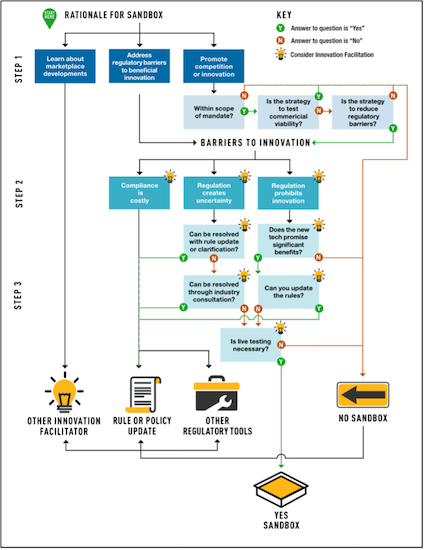
Regulatory sandboxes are just one tool that regulators can deploy to promote innovation. In some cases, other innovation approaches (e.g., traditional pilots, innovation hubs, regulatory change, track-then-act, etc.) may be more appropriate. Regulators can assess whether the risks are acceptable based on their scale and potential impacts and likelihood of customer benefits and design sandboxes to minimize risks. The flowchart below was developed for use in the Financial Technologies industry, but can be applied in the utility sector by asking similar questions and following a similar process:
Why is a sandbox necessary?
What are the barriers to innovation?
Which innovation vehicle is most appropriate?
A Flowchart for Determining Whether to Use a Regulatory Sandbox in the Financial Technologies Sector (Source: Ivo and Duff, 2020 )
If a regulatory sandbox is not the right tool, stakeholders may choose to explore other innovation vehicles, shown below.
Other Innovation Vehicles
Utility-driven approaches
R&D
Demonstrations
Pilot programs
Organizational changes that focus on innovation
Legal- or regulatory driven approaches
Topical explorations and information gathering processes
Performance-based Regulation (PBR)
Changes to legislative policies and utility regulations
Track-then-act approach
Economy-wide and broader approaches
Policy directives and vision statements
Information sharing platforms and communication tools
Innovative financing programs
Innovation hubs and incubators
Pitch fests
Technical assistance
workspace_premium Potential Benefits of Regulatory Sandboxes
The literature indicates that regulatory sandboxes are a good tool to advance objectives such as promoting innovation, advancing information collection and knowledge sharing, improving economic outcomes, increasing grid reliability and resilience, better meeting customer needs, and increasing access to technologies.
Benefit Categories:
Advancing innovation
Advance innovation within businesses (both private industry and utilities) and create spillover effects, such as new external partnerships and reduced internal silos
Advance innovation in regulation and regulatory learning by highlighting potential areas for revised regulations and identifying gaps where new regulatory guidance or public policies may be needed
Reduce the cost of innovation by removing barriers to entry for innovative technologies and solutions before deciding if the solution should be scaled
Create evidence that there is a market for innovative technologies and encourage further technological advancements
Improving information collection and knowledge-sharing
Collect insights and real-world data on new ideas
Build evidence to support a regulatory decision on a utility's plan for adopting advanced technologies
Provide opportunities for a more collaborative approach to achieve energy-related state goals
Improve coordination between regulators, governing bodies, utilities, industry, and other stakeholders, with clear and well-implemented knowledge-sharing and collaboration practices
Improving economic outcomes
Improve stakeholders' ability to identify and capitalize on new economic opportunities, moving more quickly from idea to demonstration to scale
Create new pathways for emerging energy products and services to reach commercialization, stimulating investment and new jobs
Test emerging technologies that are more cost-effective than like-for-like replacements and contribute to energy affordability
Improving grid reliability and resilience
Test emerging technologies that support grid reliability and resilience in response to changing grid conditions, such as increased penetration of variable energy resources and increasing severity of weather events
Better meeting customer needs
More nimbly address customer needs and adapt to changing customer desires such as for better access to electric vehicle charging, improved building resilience, and adoption of distributed storage technologies
Increasing access to technologies
Support access to advanced technologies for varied populations by encouraging third-party and utility collaboration and encouraging successful outcomes for all parties
warning Potential Risks of Regulatory Sandboxes
As with any regulatory tool or reform, it is important to anticipate, and aim to mitigate, any potential risks. Regulatory sandboxes do pose some risks to customers, the grid, and to other stakeholders, including possible market distortions, negative impacts to customers, the grid, or society, and undue investment of time and resources in sandbox implementation. These are shown below, along with tactics and design elements that can help to reduce these risks.
Risk Categories:
Market distortions
Create market distortions that can disrupt competition as businesses participating in the regulatory sandbox gain an advantage, creating barriers to other firms entering the market, even after the sandbox ends
Potentially erode a utility's monopoly status
Mitigation strategies: Transparent eligibility criteria, objectives, selection criteria, and exit options, level opportunities for participation by different entities, and clear (and well-implemented) knowledge-sharing obligations
Negative impacts to customers (e.g. increased costs, unintended consequences of technologies, etc.)
Negatively impact consumers as a result of the experimental nature of sandboxes and modifications to regulations intended for consumer protection (e.g. some customers may not have access to sandbox programs, sandboxes may create undue advantages for certain customer segments, rates may increase, etc.)
Negatively impact consumers when programs do not result in intended outcomes (e.g. technology costs may be higher than expected, technologies may not improve reliability or reduce load, etc.)
Mitigation strategies: Include consumer safeguards among the eligibility criteria for submitted projects, maintain technology neutrality, create flexibility to adjust to program learnings in real time or end projects early
Negative impacts to the grid or society
Fail to achieve the intended benefits of sandbox projects, resulting in negative impacts to grid reliability, safety, the environment, the economy, or other factors
Mitigation strategies: Embrace learning/failure as a successful outcome, create flexibility to adjust to program learnings in real time or end projects early
Undue investment of time and resources in sandbox implementation
Invest significant time and resources into sandbox development and implementation, distracting from other regulatory or utility needs
Fail to achieve innovation objectives of the sandbox
Act as an imperfect substitute for other regulatory change or enablers (e.g. invest time and resources into a sandbox when a simple change to a rule or policy would accomplish the same outcome)
Mitigation strategies: Deploy best practices for sandbox design, consider whether a sandbox is the appropriate innovation vehicle to meet the challenge, create clear project management tools for sandbox implementation, build in opportunities to adjust the sandbox framework over time